
Partner Content
Next-gen data centers with a natural advantage
This article is written by Joseph Alenchery, SVP & Business Head- EnergyNext, Infosys Limited.
Every few years, a country gets a rare alignment of geography, policy, and timing that puts it at the center of a global shift. For Norway, this is that moment. The world needs more data centers, and Norway has what most countries cannot offer. Clean power, cold air, and the kind of political stability that makes twenty-year contracts feel safe.
Partner Content
Next-gen data centers with a natural advantage
This article is written by Joseph Alenchery, SVP & Business Head- EnergyNext, Infosys Limited.
Every few years, a country gets a rare alignment of geography, policy, and timing that puts it at the center of a global shift. For Norway, this is that moment. The world needs more data centers, and Norway has what most countries cannot offer. Clean power, cold air, and the kind of political stability that makes twenty-year contracts feel safe.
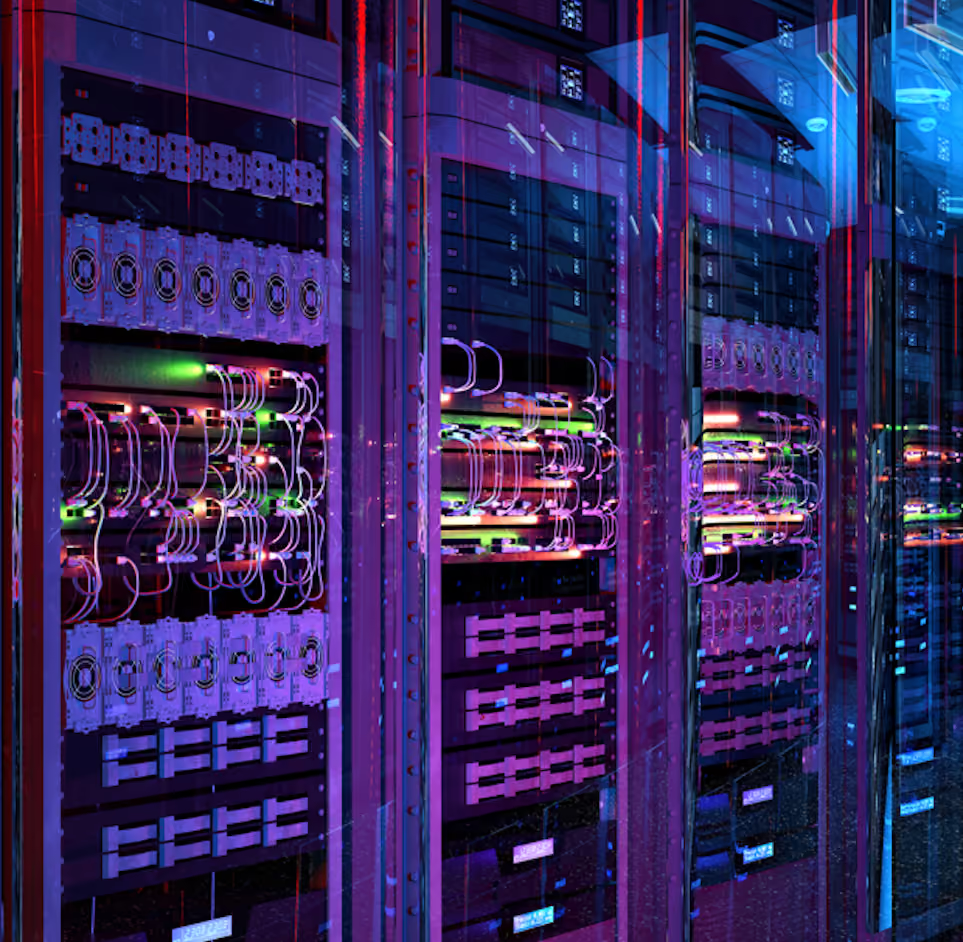

The Lefdal Mine Datacenter is about two hours from Ålesund on Norway’s western coast. The first time I visited the site, it became clear why Norway is attracting so much attention as a destination for AI infrastructure. Built inside a former mine, today Lefdal is one of Europe’s greenest data center facilities. Norway's naturally cool climate is a key factor.
This is the main reason why we brought Daimler’s high-performance computing cluster here. Through our Data Center as a Service (DCaaS) offering, Infosys manages the entire IT infrastructure at Lefdal. The site runs on 100% renewable hydropower and uses fjord-water cooling to achieve a power usage efficiency (PUE) of 1.10 to 1.15. Traditional air-cooled facilities cannot match that level of efficiency.
For Daimler, this move supports their Ambition 2039 goal of carbon neutrality. For us, it was a reminder that location is often just as important as technology.
Why Norway, and why now
Global electricity consumption from data centers grew 17% in 2025 and is expected to roughly double by 2030. Given that cooling can account for up to half of a facility’s energy use, access to natural cooling is becoming a significant advantage. Norway generates 98% of its electricity from renewable sources, primarily hydropower. Power prices in many regions remain below the European average. Combined with political stability and a supportive investment environment, these factors have helped drive data center vacancy rates down to just 6% in 2025.
The Stargate Norway project is the clearest example of this shift. A joint venture between Nscale, Aker, and OpenAI, the facility aims to deliver 230MW of initial capacity in Narvik. It will run entirely on renewable hydropower, with 100,000 NVIDIA GPUs by the end of 2026. With plans to grow beyond 500MW4, this is one of the largest AI infrastructure investments in Europe.
What the energy sector brings to the table
Data centers need reliable power supply, thermal management, real-time load balancing, and long-term infrastructure planning. These are challenges the energy industry has been trying to solve for years.
Norway’s climate and access to fjord water provide a strong foundation, but AI workloads generate far more heat than traditional computing environments. Managing that efficiently requires a combination of advanced cooling technologies, intelligent infrastructure design, and continuous optimization.
At Infosys, we use AI to predict workloads, optimize cooling systems, and balance energy demand in real time. The objective is to deliver more computing power while using less energy. Facilities like Stargate depend on exactly this kind of integration. After all, building successful AI infrastructure is all about orchestrating power, cooling, and digital systems so they operate as a unified ecosystem.
By Joseph Alenchery
SVP & Business Head- EnergyNext
Infosys Limited.